

Construction in the UK is moving at breakneck speed. Major commercial builds, infrastructure expansions and tightly controlled residential projects are demanding higher standards of onsite leadership. If you’re managing teams without a formal credential on the job at a busy construction site, then you’re missing out on a lot of career advancement. The CSCS supervisor card, also known as the CSCS gold card, is the industry standard that proves you have the technical knowledge, leadership qualities and safety awareness to manage a site workforce safely and efficiently.
It’s not just about having a shiny bit of plastic in your wallet. It’s your ticket to better pay, better job security, and to tier-one construction firms that won’t let workers without a credential do leadership work.
Navigating the pathways, understanding the specific training requirements, and avoiding common application mistakes can be incredibly overwhelming. Which is why we’ve put together this comprehensive, step-by-step guide. Construction Help Desks is committed to making your professional journey easier. We handle the complicated admin - from booking your compulsory exams to helping with card applications and qualification routes - so you can focus on leading your team.
1. What is a Gold CSCS Supervisor card?
The Construction Skills Certification Scheme (CSCS) is the primary evidence of competency on UK construction sites. If you are moving into management from hands-on trade work, the CSCS gold supervisor card is the official recognition of your transition.
This exclusive gold credential demonstrates to principal contractors, site owners and safety inspectors that you are fully qualified to manage site activities, enforce risk assessments and supervise trade teams. Without it you will hit a hard glass ceiling on your earnings and responsibilities. Major contractors won't hire without it to protect their corporate liabilities.
Key Benefits of Upgrading to Gold
- Increased Earning Potential: Supervisors holding an official gold credential earn significantly more than standard labourers or basic tradespeople.
- Access to Major Sites: Tier-one contractors and major commercial infrastructure projects will not allow you to take on supervisory responsibilities without this card.
- Career Progression: This qualification acts as the natural stepping stone toward the Black CSCS Managers Card and senior site management roles.
- Professional Authority: It validates your understanding of complex health and safety regulations, earning you immediate respect from your crew and upper management.
2. Who Needs a CSCS Supervisor Card?
Determining if this specific credential matches your day-to-day duties is crucial. If you find yourself organizing workflows, leading morning toolbox talks, reviewing safety documents, or coordinating different trades on a project, you are already acting as a supervisor.
This card is explicitly designed for:
- Site Supervisors: Professionals responsible for daily operations, safety monitoring, and team coordination.
- Gangers and Team Leaders: Experienced tradespeople who guide small squads or specific trade teams on-site.
- Assistant Site Managers: Junior managers who support senior site staff and require a recognized supervisory credential.
- Technical Specialists: Professionals with specialized trade experience who oversee specific installations, finishes, or civil engineering tasks.
If you are required to sign off on work quality, keep site diaries or make sure your crew is complying with the Health and Safety at Work Act then a gold card is no longer an option, it’s an absolute must for your operation.
3. The Prerequisites: What You Must Have Before Applying
You can’t just buy a gold card or get it with a standard reference letter. The application process is very controlled to ensure safety and professional standards are maintained across the UK. To qualify, you must satisfy two core requirements: Proof of a relevant qualification and a valid, high-level health and safety test.
The Qualification Route: NVQ Level 3 or 4
The foundation of your gold card application is a relevant construction-related National Vocational Qualification (NVQ) or Scottish Vocational Qualification (SVQ) at Level 3 or Level 4.
Unlike academic certificates, an NVQ is a work-based assessment. An assessor will review your real-world performance on-site, analyze your workplace documentation (such as site diaries, risk assessments, and induction records), and conduct professional discussions to confirm you meet the national occupational standards.
| Eligible NVQ Programs for the Gold Card |
| NVQ Level 3 in Occupational Work Supervision |
| NVQ Level 3 in Construction Site Supervision |
| NVQ Level 4 in Construction Site Supervision |
| Specialized Trade Supervision Diplomas (e.g., Demolition, Scaffolding, or Civil Engineering Supervision) |
Critical Note: Basic trade NVQs (such as a Level 2 in Bricklaying or Carpentry) do not qualify you for a supervisor card. You must achieve a specific supervisory qualification that focuses on leadership, resource coordination, and safety management.
CITB Specialist Health, Safety and Environment Test
“The second thing is passing the CITB Health, Safety and Environment Test. But a mistake many applicants make is booking the wrong version of this test.
You cannot get a gold supervisor card by using the standard operative test that is used for a green labourer card. Instead you have to sit and pass the CITB Specialist Supervisors Test.
This advanced exam assesses your knowledge of a wide array of critical supervisory responsibilities, including:
- Supervisory Law and Enforcement: Understanding your legal liabilities under UK safety regulations.
- Risk Assessments and Method Statements (RAMS): Knowing how to interpret, implement, and enforce these documents on the ground.
- Site Inductions and Toolbox Talks: Delivering clear, high-impact safety updates to your workforce.
- Occupational Health Management: Managing dust, noise, vibration, and hazardous substances (COSHH) on a busy site.
The test consists of 50 multiple-choice questions that must be completed within 45 minutes. It features a mix of general core safety questions and specialized behavioral case studies that analyze how you react to dangerous scenarios on-site. Your test score is valid for exactly two years, meaning you must submit your final card application before this window closes.
4. How to Get Your Card Step by Step
There is a strict, rational sequence you must go through to earn your credential. If you miss a step or get one wrong, your application may be rejected, your booking fees wasted and your project unnecessarily delayed.
Here below we have given the most efficient roadmap to get your card:
1. Join a Supervisory NVQ level 3 or 4: Duration: 3-12 months.
Register with an accredited training provider for your work based NVQ assessment Gather on-site documentation such as your site diaries, safety briefings and resource schedules to build a solid portfolio for your assessor.
2. Book and Pass the CITB Specialist Supervisors Test 45 minute exam.
You can book your test at a CITB centre by visiting a reputable site such as Construction Help Desks. Spend time studying the official revision materials – especially hazard perception, legal responsibilities and behavioural safety.
3. Get Your Certified Documents Together: The preparation stage.
When you receive your digital NVQ certificate from your awarding body (City & Guilds or NOCN, for example), make sure you get a good quality copy. Have your unique National Insurance number and your official CITB pass certificate available.
4. Submit Your Application and Payment and Processing: 5 to 10 working days.
Please send your completed application documents and the standard CSCS processing fee. Make sure your personal details match the names on your educational certificates to prevent any delays in processing.
5. Overcoming the "Catch-22": The Temporary Red Card Solution
A major challenge facing many aspiring site leaders is what the industry calls the "Catch-22" of supervisor cards. To get your gold card, you need an NVQ Level 3. But to complete your NVQ Level 3, you must be actively working as a supervisor on a live construction site. Unfortunately, many principal contractors will not let you step into a supervisory role without a valid card.
To solve this problem, CSCS offers a temporary transition route: the Red Experienced Technical, Supervisor or Manager Card.
The Red Supervisor Card Pathway
If you have a wealth of hands-on experience but lack the formal NVQ paperwork, you can apply for this temporary red card. The strict requirement is that you must be actively enrolled in a qualifying Level 3 or Level 4 NVQ.
- Validity: The Red Experienced Supervisor Card is valid for exactly one year.
- Non-Renewable: It cannot be extended, renewed, or reissued. Its sole purpose is to buy you 12 months on a live site so you can finish your assessments.
- Requirements: You must provide official proof of registration from your NVQ training provider and have a valid CITB Specialist Supervisors Test pass certificate.
This temporary route allows you to work legally as an on-site supervisor, earn a supervisor's wage, and systematically complete your NVQ portfolio alongside your assessor. Once your NVQ is completed and your certificate is issued, you can instantly swap your temporary red card for the permanent gold credential.
6. Another Route: Academically Qualified The AQP Route
Not all site supervisors come from a traditional vocational or trade background. An increasing population of individuals in the industry enter leadership through higher education programs, technical diplomas or professional degrees.
Alternatively, if you have formal academic qualifications instead of an NVQ, you may qualify for the CSCS Academically Qualified Person (AQP) Card.
You can use this alternative pathway if you have:
- Foundation Degree in Construction Based.
- A full Bachelor of Science (BSc) or Master of Science (MSc) in Construction Management, Civil Engineering, Quantity Surveying or similar.
- HND or HNC in a built environment subject.
To obtain this version of the card, you must send your full academic transcripts and certificates directly to CSCS for official verification. You will also have to pass the relevant CITB Health, Safety and Environmental test. The AQP card has a different layout than the standard gold card but is regarded with equal prestige by major contractors and gives you the same supervisory authority on site.
7. Understanding the Grace Period and Card Renewal
Your gold supervisor card is an investment in your career, but it doesn’t last forever. It is valid for five years from date of issue. “The key to avoiding being locked out of major construction projects is to monitor your renewal timeframes,” the report said.
The Myth of the “Grace Period”
There’s a common misconception in UK breakrooms that CSCS offers a standard grace period for professionals working on an expired card while they sort out their renewals.
First things first: there is no official grace period for entering the site at CSCS.
If your card expires on a Tuesday, you cannot legally step onto a strictly regulated site as a supervisor on Wednesday. Principal contractors using digital check-in systems or electronic turnstiles will flag your card as invalid, which can cause embarrassing site exclusions and immediate losses in daily income.
The Correct Renewal Window
While there is no grace period for using an expired card on site, CSCS does provide an administrative window to renew your credential without needing to retake your entire NVQ qualification.
You can officially renew your card up to 6 months before its expiration date and up to 6 months after it expires.
To complete the renewal process, you must:
- Retake and pass the CITB Specialist Supervisors Test (ensuring your pass date is within the last 2 years).
- Submit a formal renewal application along with the standard processing fee.
If you miss this 6-month post-expiration window entirely, the recovery process becomes significantly more complex, and you may face extensive manual verification checks to reactivate your credential.
8. Smart Tips for Your CITB Exam Preparation
The CITB Specialist Supervisors Test is notoriously difficult. Many applicants fail on the first try not because they are lacking on-site knowledge, but because they are not prepared for the specific formatting and trick options within the multiple choice question bank.
Here are some strategic study habits that will ensure you pass your exam the first time:
- Focus on Behavioral Case Studies These questions are about complex situational questions on location and are asking what you should do rather than what you are legally required to do. They’re testing your safety mindset, not your ability to memorize regulations.
- Use Official Revision Material: Download the official CITB revision applications or purchase the licensed study books. Avoid relying on outdated, unofficial online quizzes that use old question formats.
- Practice Time Management You have 50 questions to answer in 45 minutes, so you have less than a minute per question. Take full length, timed mock exams to become comfortable managing your pace.
- Read All Answer Options Carefully CITB exams often have several options that seem quite right at first glance. Watch for absolute words such as always , never or immediate to find the exact legal answer .
9. Avoid These Application Mistakes
Even construction pros with years of experience can run into problems at the application stage due to small errors in paperwork. Please take a careful look at this checklist before you submit your documentation:
1. CITB Test incorrectly booked
As we have already highlighted passing the Operative or Health and Safety Awareness test will not open the door to a gold card. You have to pass the Specialist Supervisors exam. Always recheck your test booking confirmation.
2. Variations in Spelling of Names
For example if your NVQ certificate says “Robert J. Smith” and your CITB test profile or drivers license says “Bobby Smith” then the automated verification systems will catch this mismatch. Make sure your legal name is spelled consistently on all training providers, test centres and application forms.
3. Submission of Expired Test Results
Your CITB test certificate is valid for a period of 24 months. If you did your test at the start of a long NVQ course, and it takes you a while to complete your portfolio, then your test could have expired by the time you apply for your licence. If it exceeds the two year mark, you will be required to retake the Watch Beware of cheap online courses that offer fast 'supervisory diplomas' and are not accredited. CSCS only recognises qualifications from regulated bodies such as NOCN, City & Guilds or Pearson Edexcel.ted online courses claiming to offer fast-track “supervisory diplomas”. CSCS only recognises qualifications from regulated bodies like NOCN, City & Guilds or Pearson Edexcel.
10. Partner with Construction Help Desks for a Hassle-Free Process
Getting your career credentials shouldn't feel like a full-time administrative job. Between managing daily site activities, organizing subcontractor schedules, and maintaining family commitments, finding the time to manage test dates, verify certificates, and complete complex applications is incredibly difficult.
That is where Construction Help Desks steps in. We act as your dedicated professional partner, handling the administrative heavy lifting so you can focus on your work.
How We Streamline Your Career Advancement
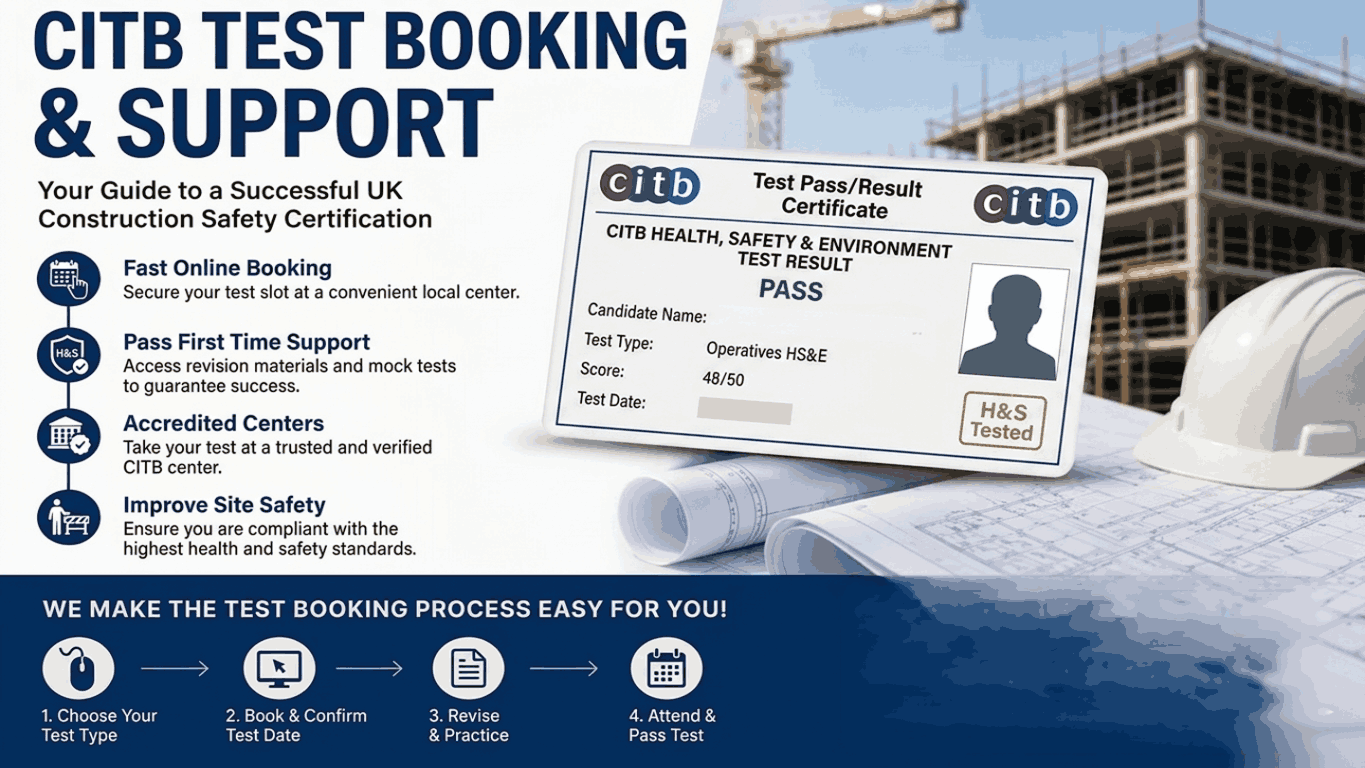
- Effortless CITB Test Bookings: Tell us your preferred location and availability, and we will secure your test date at an official, accredited CITB center near you.
- Application Management: We meticulously review your NVQ documents, certificates, and test sheets to guarantee your final application is free of errors before submission.
- End-to-End Career Support: Whether you need a provisional driving license to get between jobs, a CSCS labourer card for your crew, or are ready to upgrade to a supervisor card, our platform handles all your corporate bookings under one roof.
Don't let missing paperwork or administrative delays slow down your career. Take the next major step in your construction career today. Contact the team at Construction Help Desks to book your supervisor test, clear your application hurdles, and secure your gold card with absolute confidence.
Frequently Asked Questions
Can I get a CSCS supervisor card without an NVQ?
No. The standard gold card requires a relevant Construction NVQ/SVQ Level 3 or 4. If you do not have an NVQ but hold a relevant university degree, HND, or HNC, you can apply for the Academically Qualified Person (AQP) card instead. Alternatively, if you are currently enrolled in an NVQ, you can apply for a temporary Red Card.
What is the exact passing score for the CITB Supervisors Test?
To pass the CITB Specialist Supervisors Test, you must score at least 45 out of 50. This incredibly high passing standard highlights why thorough preparation using official study materials is absolutely necessary.
How much does a gold card supervisor earn in the UK?
While salaries vary depending on your location, trade sector, and project scale, qualified site supervisors holding a gold card typically earn between £38,000 and £55,000 per year across the UK. Contractors with extensive experience or specialized engineering skills can secure even higher day rates.
Can I manage an entire construction site with a gold card?
A gold card qualifies you to act as a site supervisor or assistant manager. However, for large-scale projects or principal contractor roles, companies usually require a Black CSCS Managers Card, which requires a Level 6 or Level 7 NVQ in Construction Management.


Reviews & Comments
No ratings yetNo approved comments yet. Be the first to share your thoughts!
Leave a Review